PetDoing Originals · Spin & battle
Pet Spin Arena
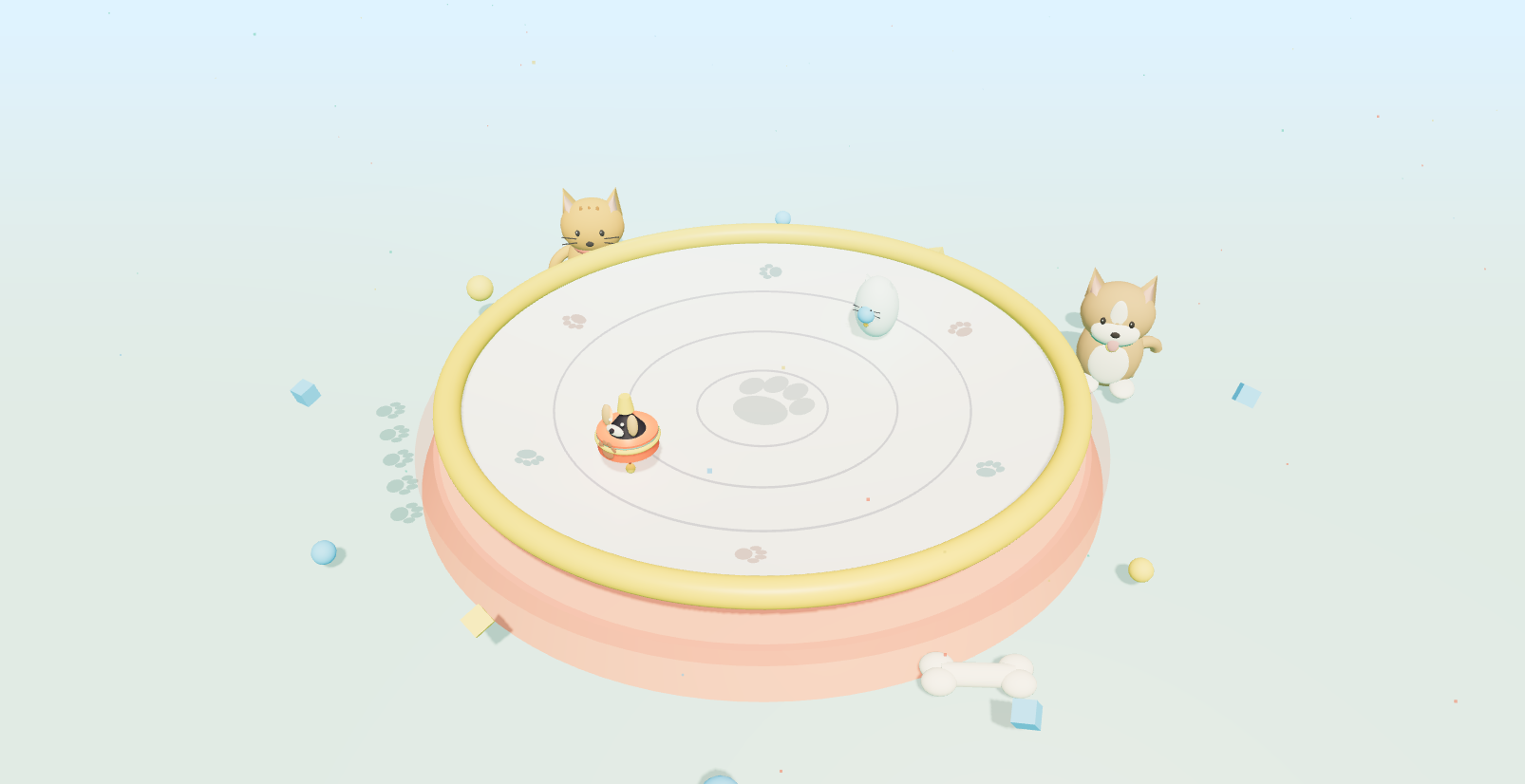
Pet Spin Arena brings our spinning-object battle game into the PetDoing playroom. Choose one of seven pet-themed shapes, launch against an AI opponent and watch the two bodies spin, graze and collide inside a shallow bowl. Your launch changes both travel speed and starting spin, so more power is a choice to explore.
Choose, launch, collide
- Pick a contender. The Puppy Paw Top is selected initially. Choose a toy card before launch, or choose “Surprise me” for a random pair. The AI uses a different shape.
- Set your opening. Adjust “Power” and choose a route: “Straight at rival” aims toward the opponent; “Loop left” or “Cut right” changes the approach. Click “Launch” to launch both sides.
- Or drag to aim. Press an open area of the arena and drag in the direction you want to launch. A longer drag gives more power; release inside the arena to begin. A short tap does not start a round.
- Watch the clash. Both toys now spin under the same physics rules. RPM shows axial spin; the stability bar drops during effective collisions. Launch controls lock during the battle.
- Try another opening. After the result, “Play again” keeps both shapes. “New rival” keeps your chosen toy and draws a different opponent, or redraws both if you selected random. The AI varies its launch, so a rematch is not an exact replay.
How a round is won
An effective impact compares the toys' rotation, mass, alignment, movement and remaining stability. One toy takes the main hit; the other loses a smaller amount. A decisive collision or exhausted stability stops the losing toy and produces a KO result.
A toy can also lose by leaving the playable bowl, falling below it or remaining too slow or too far off its axis. Brief wobbling does not immediately end the round. When both fail in the same step, remaining stability breaks the tie unless they are close enough for a draw.
The round limit is 32 seconds of simulation time. At time-up, the game compares stability plus half the remaining axial spin; close scores draw. Physics stops at settlement. A short, fading visual spin or a KO replay does not change the result.
Seven toys, different decisions
- Puppy Paw Top: the familiar centered top, with strong starting spin and a steady axis. A useful starting point for direct launches.
- Kitten Wobbler: a rounded body that can rock and lose alignment after contact. Compare a moderate launch with a full-power one.
- Mint chew ring · Mint Chew Ring: a low, hollow shape that can graze, tumble or roll. Its two faces are treated symmetrically when checking orientation.
- Squeaky duck · Squeaky Duck: the head shifts the center of mass and creates asymmetric collisions. A glancing strike can make it nod or tip.
- Paw Bell Cup: the handle changes both inertia and contact. Approach angle matters more than its simple body suggests.
- Burger plush · Burger Plush: a broad, low body with the heaviest target mass in this set. Watch how it absorbs a head-on meeting.
- Catnip banana · Catnip Banana: a curved, off-center toy with lower axial spin and less predictable travel. Its novelty comes with a harder opening to judge.
Learn from a rematch
Start with the Puppy Paw Top at the default 72% strength and the direct route. Watch whether the first meeting drains your spin or knocks the rival off balance. Keep the lineup, then try a medium-strength side route. Changing one input at a time makes the difference easier to see, although the AI opening is randomized each round.
There are no mid-round steering commands or power boosts. Your choices are shape, direction and launch strength. The session win/loss/draw tally records completed rounds only; restarting early abandons that round.
Controls and comfort
Focus the arena and press Space to use the current button settings. Escape, a right click, a second finger touching the arena or releasing outside it cancels a drag. Mouse and single-touch controls are supported. On small screens, scroll outside the arena to reach the selector and launch controls.
Sound starts muted. Use “Off” to enable rotation and impact sounds, and “On” to mute them. “Pause” pauses play; the same button resumes it. Switching tabs pauses the simulation. The system reduced-motion setting disables camera shake and decorative moving effects and skips the KO slow-motion wait.
Browser support and progress
This game needs a modern browser with WebGL and WebAssembly. Its 3D engine and physics download may take a moment. If loading fails, refresh once and check hardware acceleration. Desktop and responsive layouts are checked in Chrome; Android and iPhone touch feel still needs device testing.
Rounds and session results run locally and are not saved when you refresh or leave. This release has no multiplayer, motion-sensor control, purchases, cash prizes or gameplay account requirements.
About this adaptation
The original spinning-top project's shallow bowl, seven compound shapes, launch physics, passive spin loss, collision damage and victory rules are retained. Mango the cat and Biscuit the corgi watch from the edge of a paw-print bowl. The Puppy Paw Top has floppy ears and a collar; the Kitten Wobbler has whiskers and a bell. PetDoing adds pet-toy visuals, player selection, accessible launch controls and rematches. The artwork is procedural 3D geometry; the cover is captured from the actual game. Plush and rubber materials are visual themes applied to rigid-body simulation.
Explore the relaxed Pet Toy Room · Try Pet Card Flip · About PetDoing · Report a problem